
The procedures and examples below are editorial tools. They describe a possible approach, not a test conducted by the named initiative.
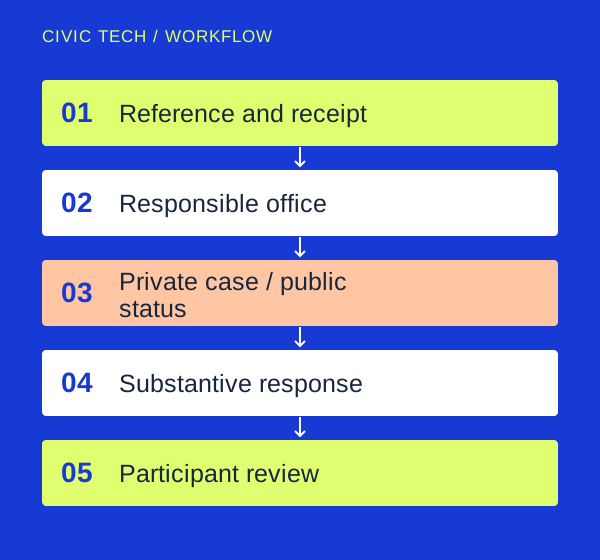
- Reference and receipt
- Responsible office
- Private case / public status
- Substantive response
- Participant review
A channel needs a recipient
SEMA and Loop appear in the May 2024 booklet as different approaches to public-service and governance feedback. Their descriptions provide a starting point for design, not proof that a new tool will obtain a response. Agree with the receiving institution which subjects it handles, which contact owns each case and what happens when a report belongs elsewhere. Publish these boundaries before asking people to submit personal information.
Create a reviewable case record
Assign a reference, a category and a receipt time. Collect only the information needed to route the case. Keep the public status separate from names, contact details and sensitive attachments. Define statuses with real meaning: received, awaiting clarification, referred, answered and closed after review. Avoid treating an automated acknowledgement as a substantive response. Give staff a way to correct mistaken classifications without erasing the history.
Return the response to the participant
Ask the institution for a specific response format: action proposed, responsible office, next step and the date of the update. If a case cannot be resolved, explain why and provide the applicable review route. Let the participant indicate whether the response addressed the issue. A public dashboard can publish aggregated categories, unresolved cases and response times, provided small counts do not expose individuals.
Review failures as well as activity
Inspect unanswered cases, repeated referrals and topics that the service cannot handle. For a trial, measure receipt-to-first-substantive-response time and the share of cases with a documented answer. State the period, denominator and exclusions. Do not infer satisfaction from closure alone. Review deletion rules and access permissions with the case owner; volunteers should not retain private exports after their assignment ends.
Working template
- Reference and receipt
- Responsible office
- Private case / public status
- Substantive response
- Participant review
Illustrative example
A hypothetical broken-water-point report is acknowledged, routed to the maintenance office and updated after inspection. Mark it “answered” when a reasoned response exists; mark it “resolved” only when the applicable evidence supports that outcome.