
PROGRAMME → PRACTICE
Innov4Democracy 2024: from a competition to a maintained service
Read the organiser’s results and use a practical handover checklist to assess what happens after a civic tech hackathon.
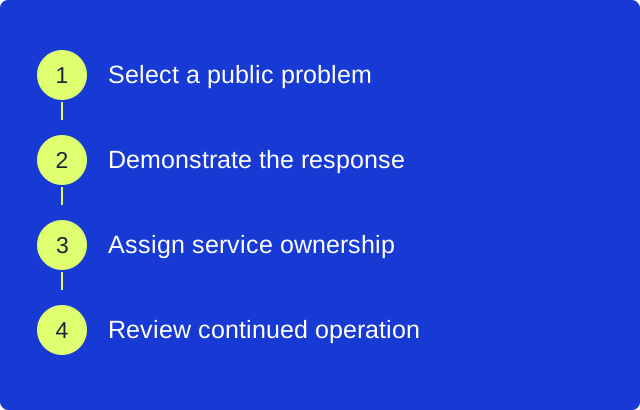
- Select a public problem
- Demonstrate the response
- Assign service ownership
- Review continued operation
What the organiser records
AfricTivistes reports 26 submitted solutions, ten shortlisted projects and five laureates. The final took place in Abidjan on 21–22 May 2024; Isika from Madagascar won. The five laureates received EUR 5,000 each and four months of technical support. These figures describe that competition, not a currently open grant.
Read the five finalist briefs
The organiser named RatomaTech in Guinea, Nidoroualmewaafe in Chad, Clic Citoyen in Benin, CitoyenSN in Senegal and Isika in Madagascar. Their proposals addressed local information, social needs, access to institutions, legal information and citizen participation. A finalist description establishes the proposed purpose; it does not independently prove current operation or an impact claim.
Separate the announcement from delivery
The initial Charter announcement described planned support. The organiser’s later account reports the event and four months of mentoring. Keep those records in sequence rather than assuming every initial timetable was delivered unchanged. The public vote and jury were selection mechanisms, not measurements of citizens’ longer-term benefit.
Plan the service after the pitch
Name the institution or team that will answer incoming requests. Agree which public information can be published, who corrects an error and how a user can contest a misleading result. Calculate the recurring hosting and maintenance workload separately from the prototype budget. Before expanding to a new locality, test whether the receiving organisation can sustain the response.
Try the method
Working example: a local information prototype has a polished search interface but no update owner. Before adding more records, assign one publisher and a correction route, test one outdated record and document the resolution time. This is an assessment exercise, not a test of any named finalist.
- User’s public-information need
- Response or correction route
- Operating owner and cost
- Evidence needed before expansion