
PROGRAMME → PRACTICE
Pan-African citizen consultation 2023: prepare a policy contribution
Two recovered Charter Project documents connect thematic consultation with a country brief. Use them to write a focused, traceable contribution.
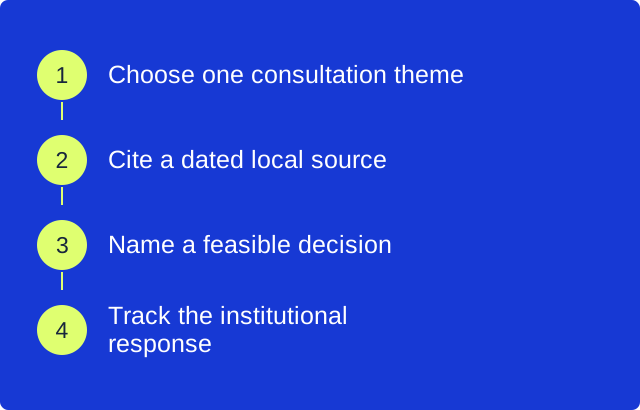
- Choose one consultation theme
- Cite a dated local source
- Name a feasible decision
- Track the institutional response
The recovered consultation outline
The four-page AfricTivistes outline describes a May–July 2023 online consultation as part of the Charter Project Africa. It invites contributions from Africa and its diaspora on four themes: elections; digital space and youth; women and vulnerable people; and public-policy monitoring. The stated closing date is 30 July 2023. This is a historical consultation, not a current submission deadline.
Read a country brief in its own period
The second recovered document is a two-page account of Senegalese civil society by Abdou Aziz Cissé, uploaded to the partner library on 20 June 2023. It discusses organisations and political debates in that period. The body is in English even though the catalogue labels its language French. Its author’s analysis should be read as a dated account, not a description of Senegal’s current political situation.
Turn a theme into one decision question
Choose a theme, then identify one change a specific institution could make. State the affected group, the geographic scope and the source of your observation. Do not copy an old statistic into a current brief without checking its date and underlying dataset. Explain whether your material is a documented event, a participant’s account or your own recommendation.
Prepare a contribution someone can act on
Write the problem in one paragraph and attach the relevant source page. Name a practical action, the responsible body and a way to check the response. Give the receiving team a safe route to clarify your evidence. Keep the original document and your interpretation distinguishable, and record a follow-up question when there is no proof of implementation.
Original source files
Historical source documents in English, provided unchanged. These pages are new editorial readers, not verbatim reproductions of the original announcements.
- AfricTivistes / Pan-African consultation / May–July 2023 / 4 pages
Download PDF ↓ · Publisher’s copy ↗ - Abdou Aziz Cissé / Senegal civil society / 2023 / 2 pages
Download PDF ↓ · Publisher’s copy ↗
Try the method
Example contribution outline: “A public-service notice is unavailable in a language used by the affected community. The attached dated notice shows the gap. Ask the responsible office to publish an accessible version and document its response.” This is an illustrative exercise, not a finding from the 2023 consultation.
- Theme and affected group
- Dated source and limitation
- Requested action and institution
- Response evidence or open question