ECDPM / 2023-09-11
Prepare a SADC engagement plan
Build a route that remains usable when access is uncertain.
The original research
The 2023 study examines ad hoc civil society engagement with SADC and uncertainty, at that time, around a proposed mechanism for non-state actors.
Enea Katundu; Martin Ronceray; Nompumelelo Runji · 2023-09-11
Read the original PDF ↗The procedures and examples below are learning tools. They describe a possible approach, not a test conducted by the named initiative.
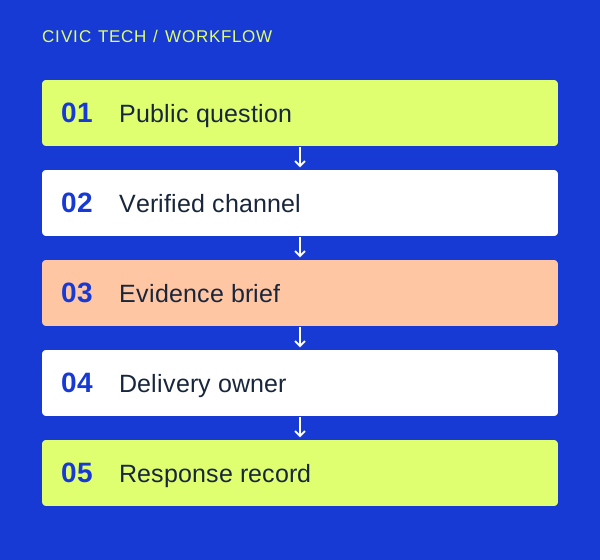
- Public question
- Verified channel
- Evidence brief
- Delivery owner
- Response record
Confirm the participation route
Treat the 2023 discussion of a proposed non-state actor mechanism as historical. Verify the present route with the relevant body before describing it as available. Identify a regional question that cannot be answered by collecting national comments alone. Make clear which organisation will convene the participants, check evidence and follow up on the submission.
Prepare the evidence
Prepare a channel inventory: recipient, subject, official source, access conditions, known contact and last verification date. Mark unconfirmed routes as unconfirmed. Plan an accessible community briefing alongside the digital work so the process can continue if the online route is unavailable. A workshop or email is an activity; it is not proof that a regional framework accepted the proposal.
Apply the method
For an illustrative cross-border youth brief, write a common policy question but retain each country’s evidence, limitations and consent rules. Agree a single delivery owner and publish the outcome of each attempted contact. Do not pool individual records without a specific purpose and a suitable basis. The exercise is not evidence that a new SADC participation mechanism has been adopted.
Working template
- Public question
- Verified channel
- Evidence brief
- Delivery owner
- Response record
Sources and provenance
Turn a participation question into a verifiable enquiry
The SADC study discussed above is a dated research source. It does not open a standing call or authorise an organisation to submit through any convenient address. To turn a recommendation into a practical next step, identify one current official route and state exactly what it is known to do.
A completed route record
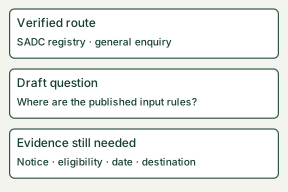
The SADC contact page consulted on14November2026 lists [email protected] as a Secretariat contact. Record its role as a general enquiry route. The contact page does not, by itself, establish an open consultation, an application deadline, eligibility for funding or acceptance of an unsolicited policy brief. Keep those fields marked “not established by this source”.
- Purpose: find the published procedure for civil-society policy input, rather than submit an application without instructions.
- Recipient: the official Secretariat registry, copied from the SADC contact page. Do not substitute an address quoted only in an old event announcement.
- Evidence: save the official page URL and checking date; note whether it specifies a relevant directorate or route. Recheck before using the address.
- Status: draft only; no message sent and no acknowledgement or opportunity confirmed.
A short draft to adapt
Subject: Request for published civil-society input procedure.
Please point us to the current published procedure, responsible unit and any applicable notice for civil-society organisations wishing to provide a regional policy brief on participation. We are seeking the correct route before making a submission. If a particular consultation is required, where are its eligibility rules, format and closing date published?
This is a fictional preparation template, not correspondence already exchanged. Add only the minimum genuine organisational context needed for routing; do not attach personal records or sensitive community evidence to an exploratory enquiry.
Decide from the reply, not from the act of sending
If a reply links a current notice, record its exact title, dates, conditions, format and destination before deciding whether it fits the project. If it only redirects you to another office, keep the application status unconfirmed. If there is no reply, the record remains an unanswered enquiry. Neither a sent message nor a contact address is proof of a grant, partnership, endorsement or accepted submission.