
PROGRAMME → PRACTICE
Women and youth in civic participation: start with access
An original AU webinar document provides the programme context. A participation audit turns that context into a usable project design.
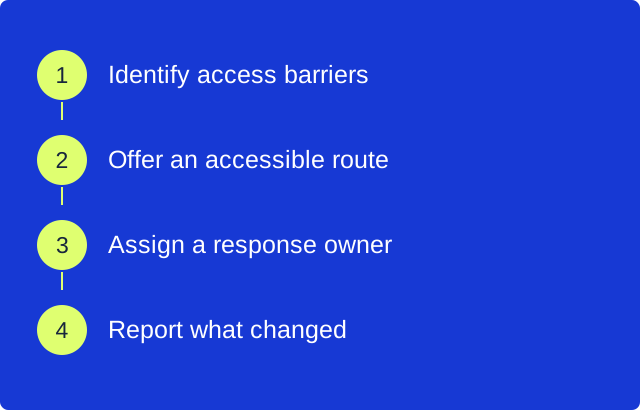
- Identify access barriers
- Offer an accessible route
- Assign a response owner
- Report what changed
The original announcement
The African Union’s media advisory is dated 3 January 2022 and announces a webinar for 10 January 2022 at 14:00 East Africa Time. It focuses on women, youth, digital tools and active citizenship. The document describes a planned panel and audience questions; it does not establish who ultimately attended or what the event achieved.
The programme connection
The advisory identifies the AU as host, EPD as manager and GIZ as financial supporter of the African Union Civic Tech Fund, with an AfriLabs virtual accelerator. It gives particular attention to youth and women-led initiatives. This is the programme description in the 2022 document. Historic registration links and media contacts are not presented here as current application routes.
Check access before promotion
Map who cannot use the proposed channel: people with limited data, shared phones, language barriers, accessibility needs or little time. Ask about an acceptable contact method without collecting unnecessary sensitive information. Provide a route for people who cannot attend live. Avoid treating an invitation sent as proof that the intended group had an opportunity to participate.
Make participation lead to a response
For each issue raised, record the receiving institution, a response date and how contributors will hear what happened. Publish an accessible summary of the questions and decisions, with consent and safe aggregation. Review whose concerns remain missing. A balanced attendance list is useful, but it cannot replace evidence that contributions influenced a decision.
Assess the risks of digital participation
The recovered ECDPM paper, From hashtags to the streets, is dated June 2022 and names Maëlle Salzinger, Lidet Tadesse and Martin Ronceray as authors. It examines opportunities and limitations of digital activism. For your project, check who lacks a safe device, who may face harassment and whether a public contribution could expose personal information. Offer private or offline participation where appropriate, and explain who can remove a harmful disclosure. These are planning questions, not a claim that the same risk affects every community.
Original source files
Historical source documents in English, provided unchanged. These pages are new editorial readers, not verbatim reproductions of the original announcements.
- AU / Women and youth webinar / 3 January 2022 / 2 pages
Download PDF ↓ · Publisher’s copy ↗ - ECDPM / From hashtags to the streets / June 2022 / 38 pages
Download PDF ↓ · Publisher’s copy ↗
Try the method
Working example: a consultation allows short voice messages before a meeting and a text summary afterwards. The team checks whether contributors receive answers and offers a correction route. The exercise is a planning example, not a claim about the 2022 webinar.
- Participation barrier
- Alternative contribution route
- Responsible responder
- Decision and feedback date