
The procedures and examples below are editorial tools. They describe a possible approach, not a test conducted by the named initiative.
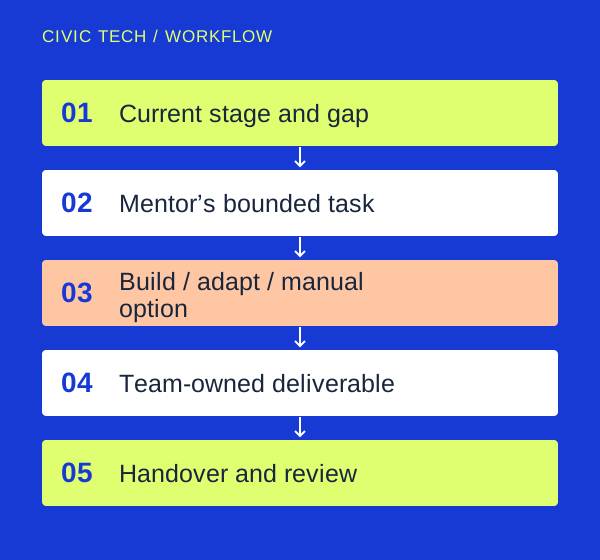
- Current stage and gap
- Mentor’s bounded task
- Build / adapt / manual option
- Team-owned deliverable
- Handover and review
Match support to the actual stage
The pilot portfolio described in the May 2024 booklet separates four start-up initiatives, three scale-up initiatives and seven expansion initiatives. Those are categories of that historical portfolio, not eligibility rules for a current programme. They illustrate why support should depend on the team’s delivery gap. An early team may need to validate a public problem; a working service may need reliable operations; a mature initiative may need partnerships and a transferable method.
Write a support brief
Choose a problem the mentor can help solve and a deliverable that the team can maintain afterwards. State the current workflow, what has been tried, available time and the decisions the team still owns. Specify civic and technical needs separately. A mentor who reviews database access does not automatically provide the institutional relationships needed for a public response. Agree on confidentiality and access before sharing participant records.
Decide whether to build or reuse
Compare adapting an existing tool, a manual workflow and building new software. Include maintenance, accessibility, moderation, training and exit costs. Run the same representative task through each feasible option. Record the reason for the choice; novelty is not an outcome. Avoid assigning a numerical return or claiming a product test unless you actually have the required evidence. A prototype should demonstrate the process before committing to a larger system.
Make the handover concrete
Arrange reviews around deliverables rather than only meetings. A useful handover includes the workflow, responsible people, an access register, maintenance tasks, known limitations and a next-review date. Test that someone other than the mentor can complete the agreed task. Remove temporary access after the assignment. Record what remains unresolved so a short mentoring engagement does not create a false impression of readiness.
Working template
- Current stage and gap
- Mentor’s bounded task
- Build / adapt / manual option
- Team-owned deliverable
- Handover and review
Illustrative example
An illustrative feedback team asks a mentor to compare an assisted intake process with an existing ticket tool. Its deliverable is a documented routing workflow and staff handover, not a promise that a new app will increase civic participation.