
The procedures and examples below are editorial tools. They describe a possible approach, not a test conducted by the named initiative.
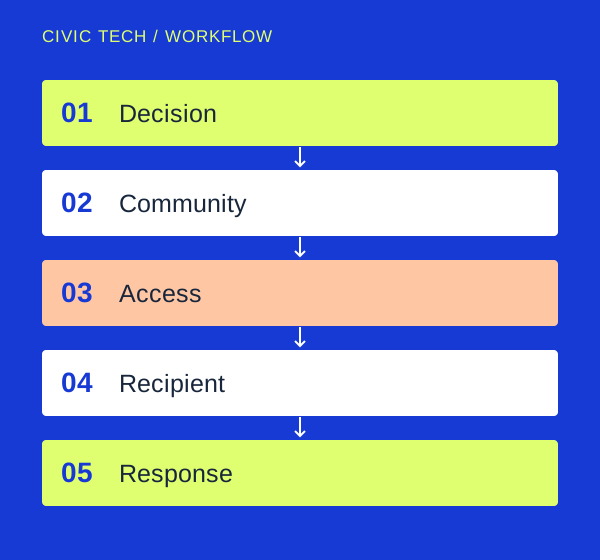
- Public decision
- Affected community
- Participation barrier
- Receiving institution
- Response and review
Define the participation problem
Civic tech uses technology to help people participate in public life, organise evidence or hold decision-makers accountable. A website alone does not establish that purpose. Start by naming a public decision, the people affected and a usable route for their views to reach someone who can act. A registration form that collects opinions but never delivers them to a responsible institution leaves the most important part of the process unfinished.
Read examples by mechanism
The May 2024 Charter booklet describes several different mechanisms: Dokeza connects annotations to draft legislation; Loop provides a feedback channel for rural youth; PromessasCV concerns electoral promises; and VOTE-BOT provides voter information. These are historical descriptions, not endorsements of their current availability. Use them to ask which mechanism fits your problem. Information access, a discussion space and a complaint-routing service require different staffing, evidence and safeguards.
Design the smallest useful trial
Draw the current journey before choosing software. Find where people lose information, access or a response. Test one changed step with a small group and an institution willing to receive the output. Provide an offline or assisted route if connectivity, language or disability would exclude participants. Establish who reviews submissions, how questions are answered and when personal data is removed. Record what did not work alongside successful interactions.
Judge the result
A useful trial asks whether a participant could complete the task and whether the responsible person could use the result. Page views and registrations can describe reach; they cannot alone demonstrate changed governance. Choose one observable outcome, such as receipt of a submission, a documented response or a corrected public record. Set a review date before launch. If the response route is missing, resolve that relationship before adding features.
Working template
- Public decision
- Affected community
- Participation barrier
- Receiving institution
- Response and review
Illustrative example
For an illustrative consultation on opening hours, an assisted paper form may reach excluded residents better than a new app. A digital register can organise their submissions and record the authority’s response. This is a design example, not an observed project outcome.